Chapter 3: Fourier Series
Introduction
The Fourier series represents periodic signals as a sum of harmonically related sinusoids or complex exponentials.
Periodic Signals
Definition: Periodic Signal
A signal
The fundamental frequency is
Complex Exponential Fourier Series
Theorem: Fourier Series Representation
A periodic signal
where the Fourier coefficients are:
Properties of Fourier Coefficients
Proposition: Symmetry Properties
For a real signal
(conjugate symmetry) (even magnitude spectrum) (odd phase spectrum)
Representation: Line Spectra
The Fourier series representation can be visualized using line spectra, which show the magnitude and phase of each harmonic component.
Definition: Line Spectra
For a periodic signal with Fourier coefficients
- Magnitude Spectrum (or Amplitude Spectrum): A plot of
versus - Phase Spectrum: A plot of
versus
The line spectra are discrete, with non-zero values only at integer multiples of the fundamental frequency
Properties:
For real signals
- The magnitude spectrum is even:
- The phase spectrum is odd:
- Only the positive frequencies (k ≥ 0) need to be displayed due to symmetry
Interpretation:
- Each line at frequency
represents a harmonic component - The height of each line indicates the amplitude of that harmonic
- The DC component
represents the average value of the signal - Higher harmonics contribute to the fine details and sharp transitions in the signal
- The rate of decay of
as indicates the smoothness of the signal: - Discontinuities → slow decay (e.g.,
) - Continuous but non-smooth → faster decay (e.g.,
) - Smooth signals → rapid decay (e.g., exponential)
- Discontinuities → slow decay (e.g.,
Example Visualization:
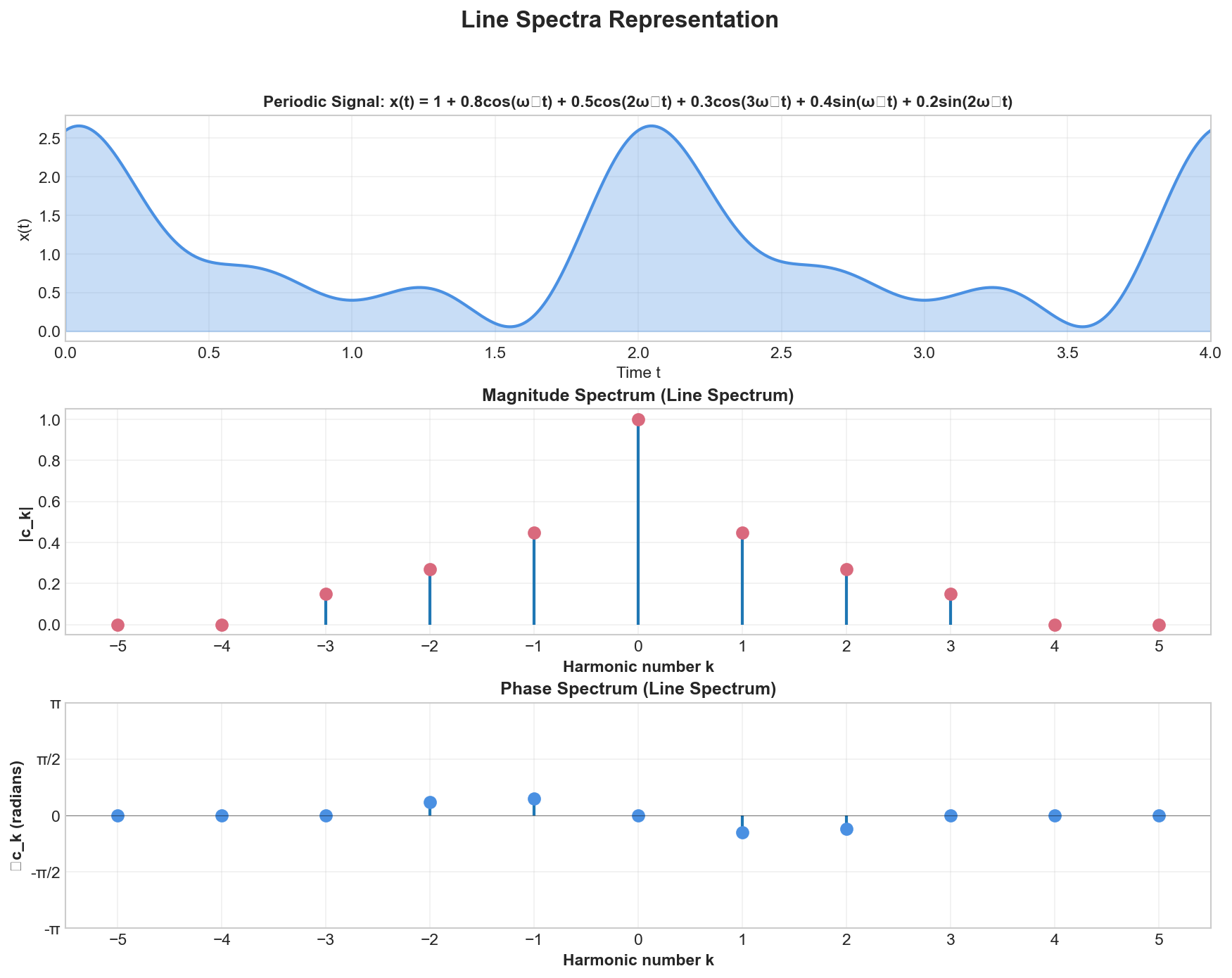
The figure illustrates line spectra for a periodic signal composed of a DC component and three harmonics. The magnitude spectrum (middle) shows the even symmetry property:
Trigonometric Fourier Series
Definition: Trigonometric Form
For real signals, the Fourier series can be written as:
where:
Relationship Between Forms
Parseval's Theorem
Theorem: Parseval's Theorem for Fourier Series
The average power of a periodic signal equals the sum of powers in each harmonic:
Properties of Fourier Series
| Property | Time Domain | Frequency Domain |
|---|---|---|
| Linearity | ||
| Time Shift | ||
| Frequency Shift | ||
| Time Reversal | ||
| Differentiation | ||
| Convolution |
Convergence
Definition: Dirichlet Conditions
A periodic signal
is absolutely integrable over one period has a finite number of maxima and minima in one period has a finite number of discontinuities in one period
Examples
Example 1: Square Wave
Consider a square wave with amplitude
The Fourier coefficients are given by :
This gives the series:
Demonstration
Computing the Fourier coefficients:
We compute
For
For
Evaluate each integral using
where we used
Substituting back:
Since
Now,
Thus:
Deriving the trigonometric series:
For odd
The contribution from harmonics
Summing over odd
Visualization:
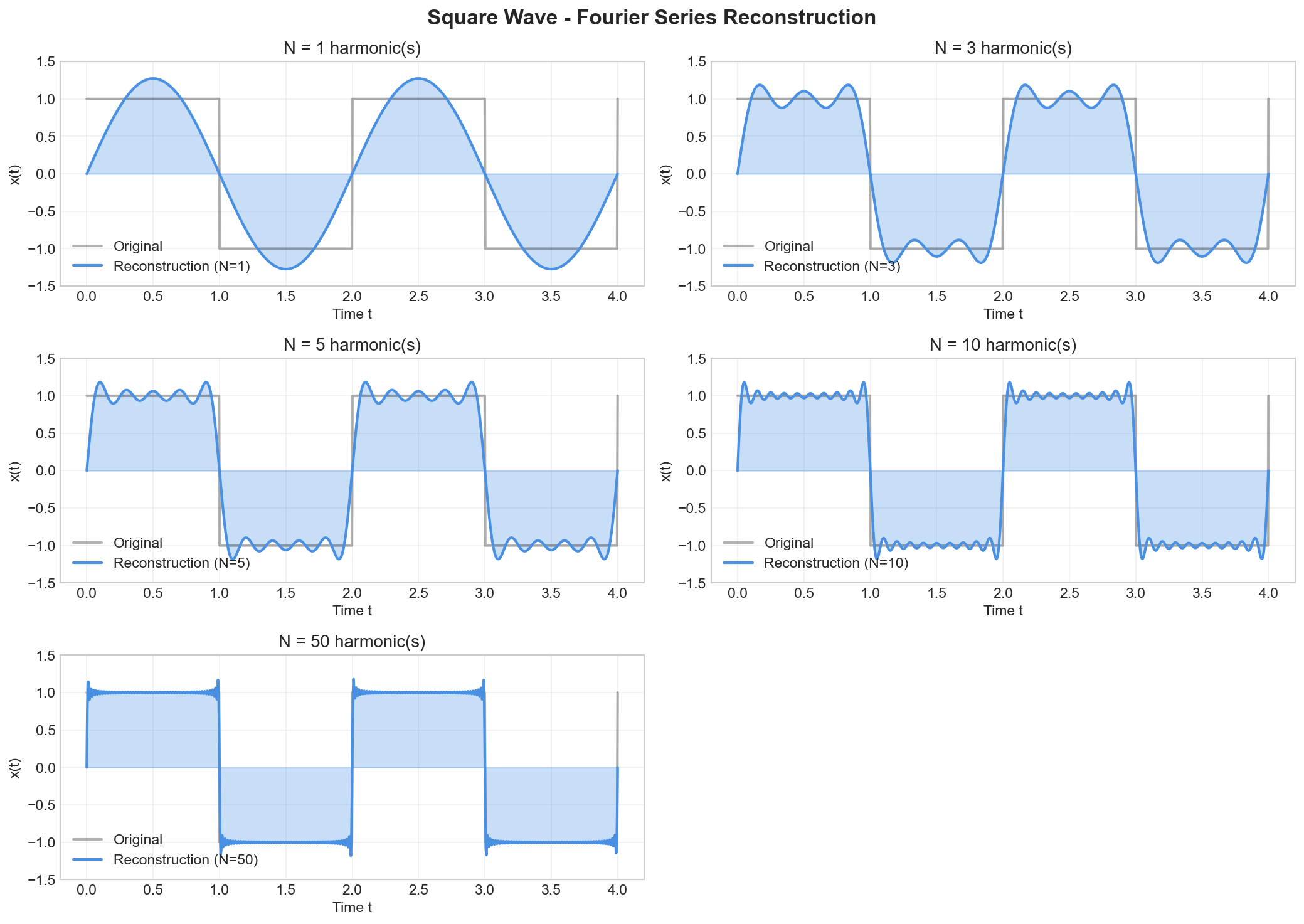
The figure above shows how the Fourier series approximation improves as more harmonics are added. Notice the Gibbs phenomenon at the discontinuities - the overshoots persist even with many harmonics.
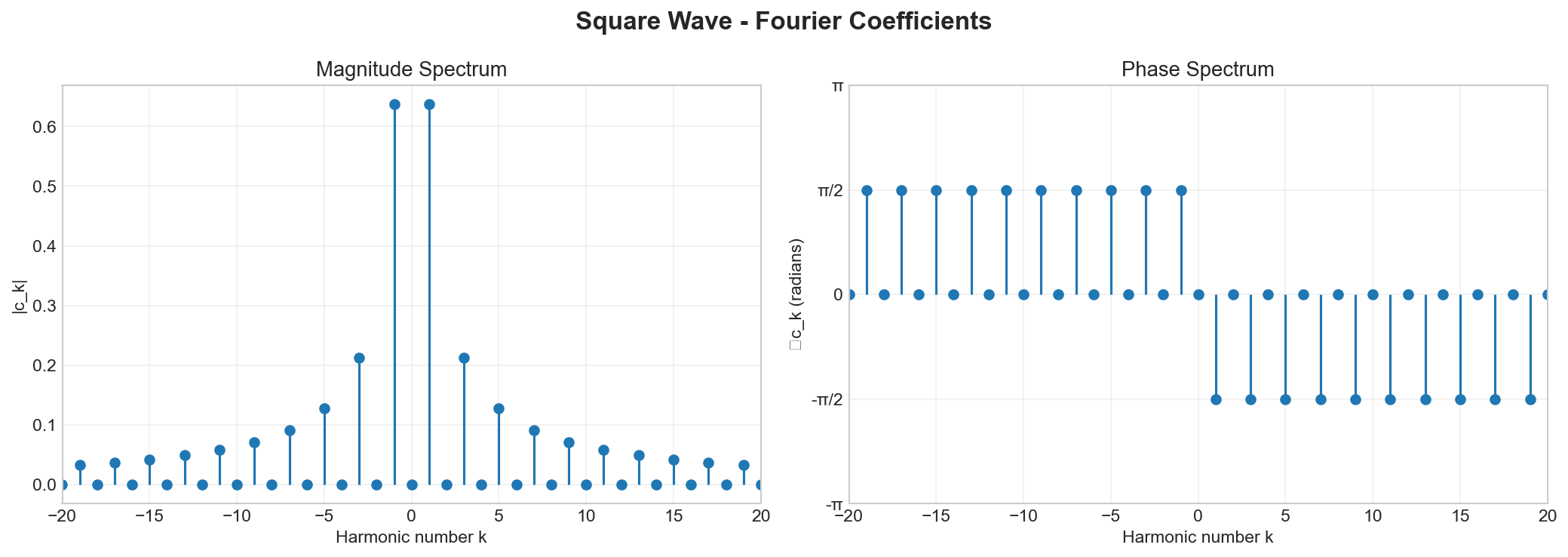
The magnitude spectrum shows that only odd harmonics are present, with magnitude decaying as 1/k. The phase spectrum shows that all coefficients have phase ±π/2.
Example 2: Sawtooth Wave
Consider a sawtooth wave increasing linearly from
The Fourier coefficients are given by :
This gives the series:
Demonstration
Computing the Fourier coefficients:
We have
Observation: Since
For
For
Use integration by parts with
Evaluating the first term:
Since
Evaluating the second term:
(since
Therefore:
Since
Deriving the trigonometric series:
For the real signal with odd symmetry, we have
By conjugate symmetry,
The contribution from harmonics
Summing over all
Visualization:
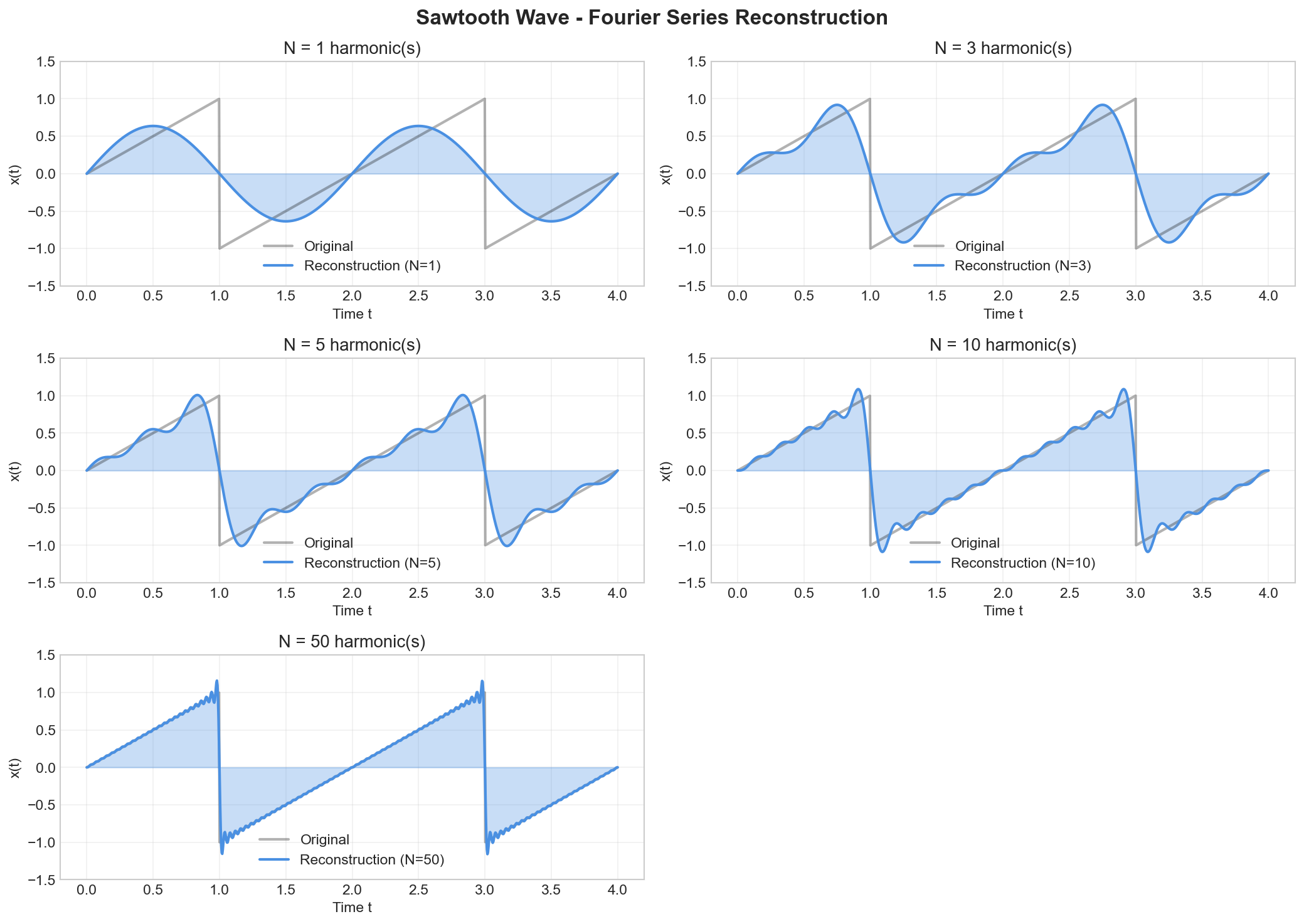
The figure shows the Fourier series reconstruction of the sawtooth wave. The convergence is smoother compared to the square wave since the sawtooth has no discontinuities, only a discontinuity in the derivative.
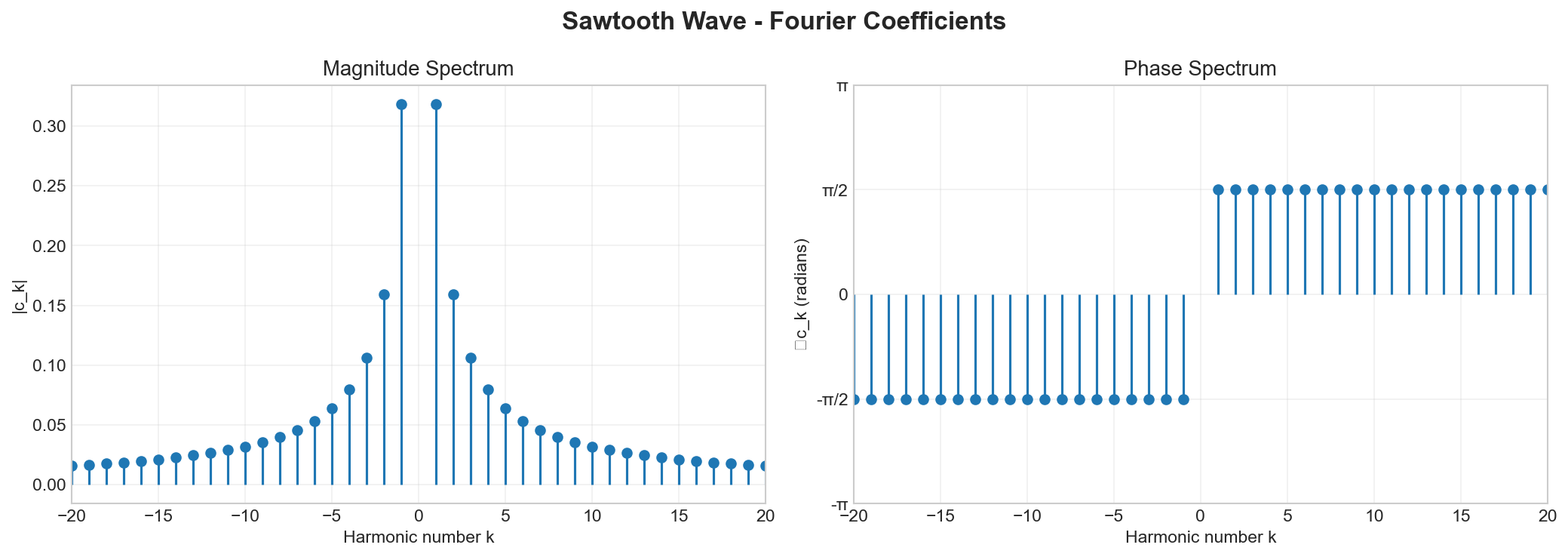
The magnitude spectrum shows all harmonics (both even and odd) are present, decaying as 1/k. The phase spectrum shows alternating phases of ±π/2, corresponding to the alternating sign in the series coefficients.
Example 3: Pulse train with duty cycle
Consider a periodic pulse train of period
The Fourier coefficients are given by :
Thus the complex Fourier series:
Demonstration
Computing the Fourier coefficients:
We compute
For
This is the DC component (average value) of the signal.
For
Evaluate the integral:
Since
Since
Alternative form using the sinc function:
We can rewrite the coefficient using Euler's formula. Note that:
We can also express this as:
where
Summary of results:
The complex Fourier series is:
Visualization:
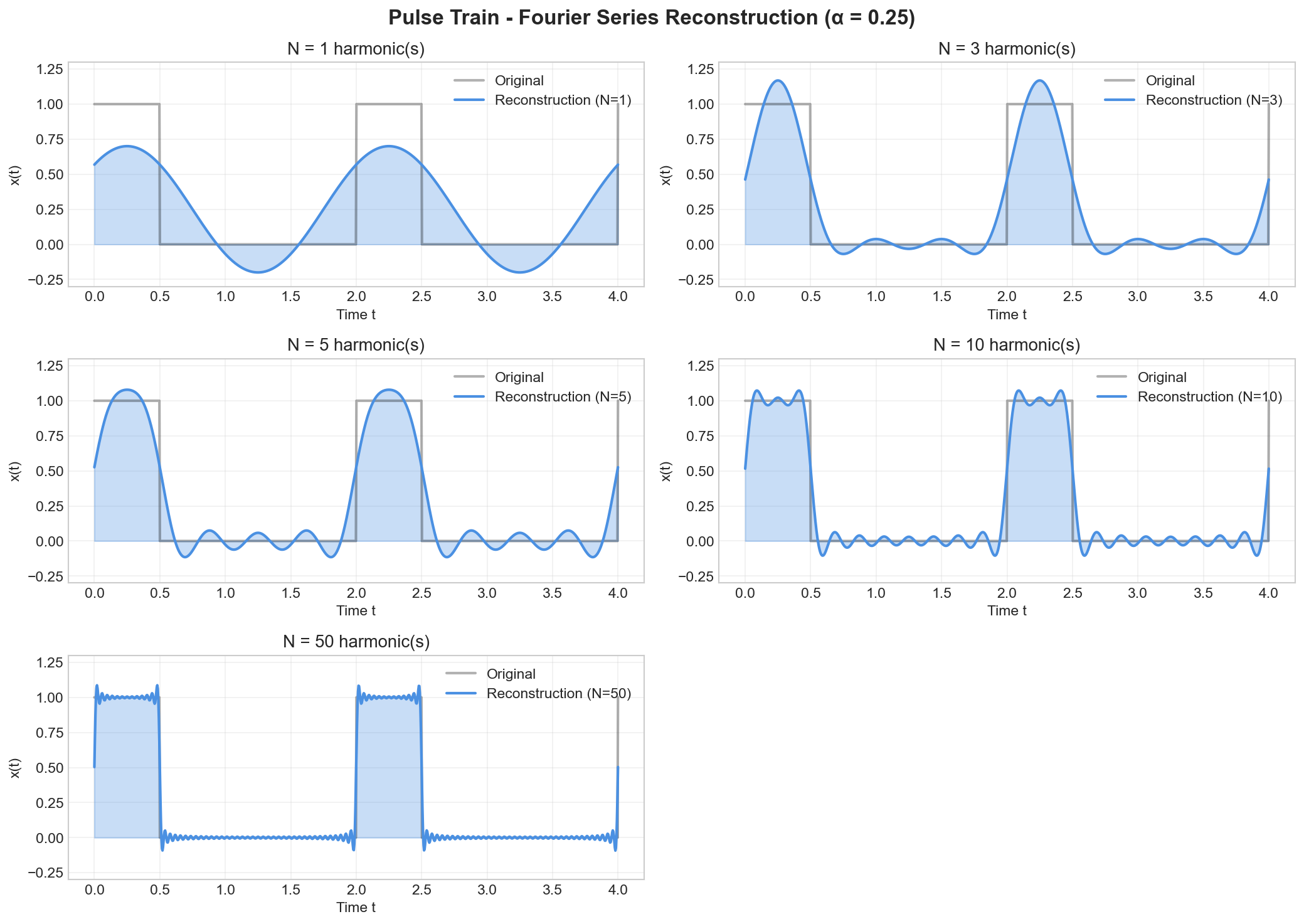
The figure shows the Fourier series reconstruction of a pulse train with 25% duty cycle (α = 0.25). As more harmonics are added, the reconstruction improves, with the Gibbs phenomenon visible at the discontinuities (similar to the square wave). The DC component c₀ = Aα = 0.25A gives the average value.
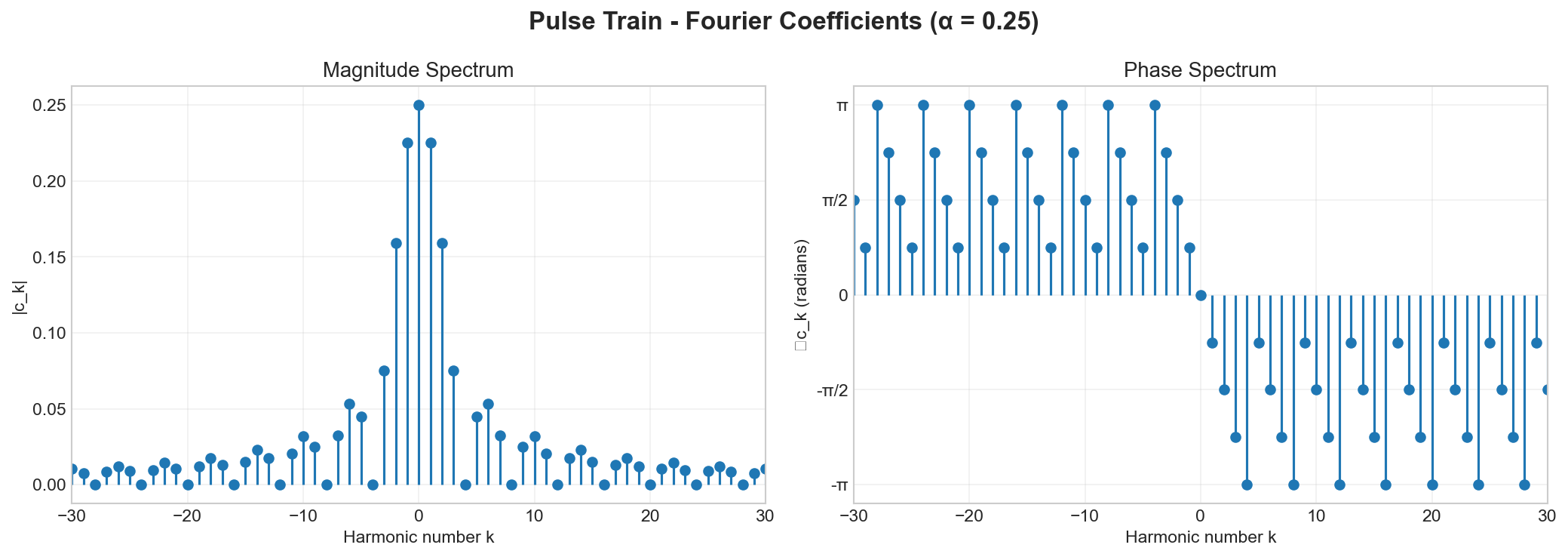
The magnitude and phase spectra for a 25% duty cycle pulse train. Notice that all harmonics are present (unlike the square wave which has only odd harmonics). The DC component c₀ = 0.25A is visible at k = 0. The narrow pulse (25% duty cycle) requires more harmonics for accurate reconstruction.
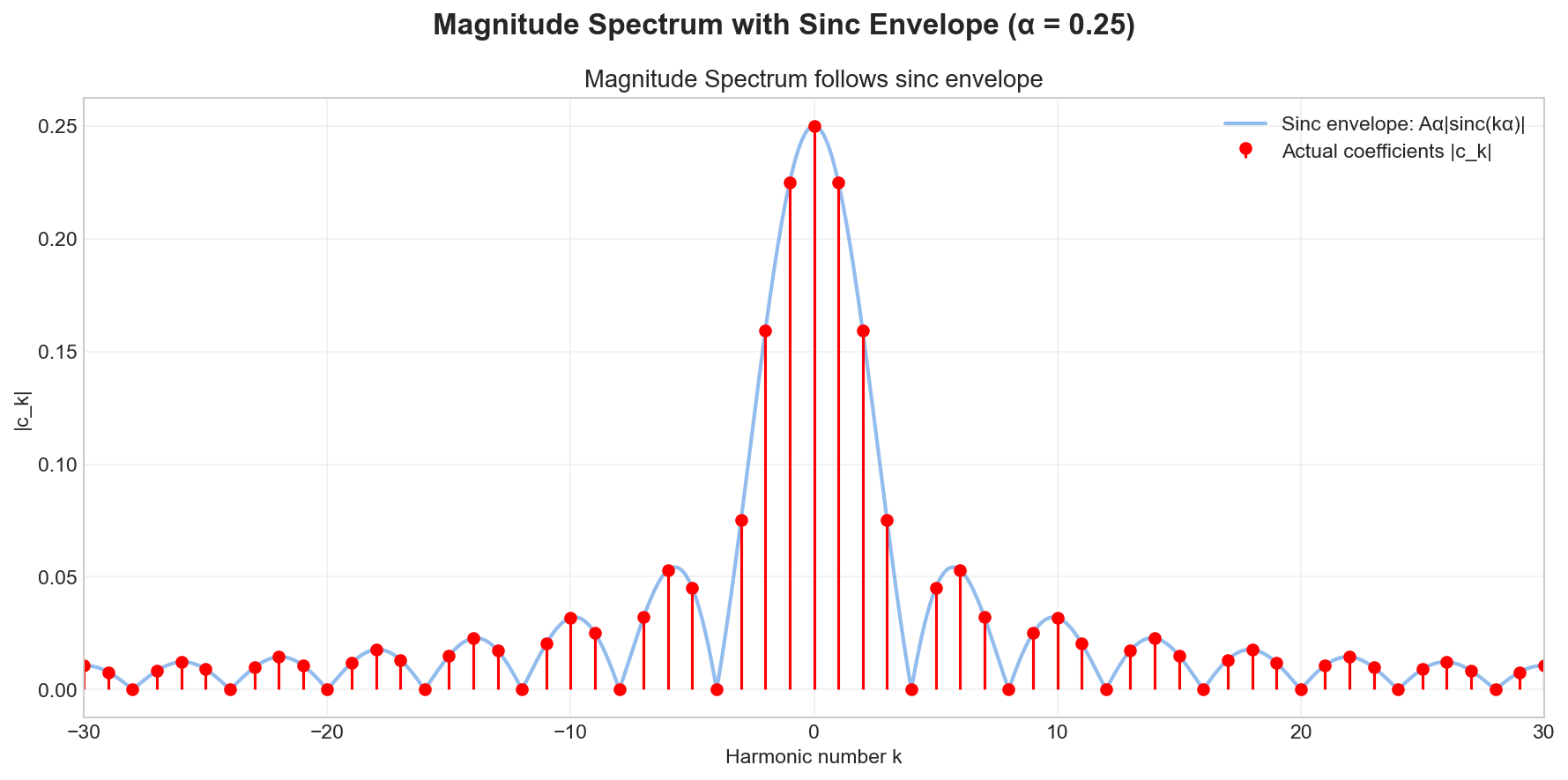
The magnitude spectrum follows a sinc envelope, as predicted by the analytical formula |c_k| = Aα|sinc(kα)|. The zeros of the sinc function occur at integer multiples of 1/α, which for α = 0.25 means zeros at k = ±4, ±8, ±12, etc. This is characteristic of rectangular pulses: narrower pulses (smaller α) have a wider sinc envelope, requiring more harmonics for accurate reconstruction.