Chapter 4: Fourier Transform
Introduction
The Fourier series is a powerful tool for analyzing periodic signals, but many real-world signals are aperiodic (non-periodic). To analyze these signals, we extend the Fourier series to create the Fourier Transform. This chapter introduces the Fourier Transform and demonstrates how it emerges naturally from the Fourier series as the period approaches infinity.
From Fourier Series to Fourier Transform
The Fourier series is limited to periodic signals. To analyze aperiodic (non-periodic) signals, we extend the Fourier series by letting the period
Intuition: As the period increases, an aperiodic signal can be viewed as a periodic signal with infinite period. The fundamental frequency
Derivation:
Starting from the Fourier series:
where
Substituting
As
(becomes infinitesimal) (discrete frequencies become continuous) (sum becomes integral) - Integration limits:
This yields:
Fourier Transform Pair
Definition: Fourier Transform and Inverse Fourier Transform
For an aperiodic signal
and the Inverse Fourier Transform is:
We write:
Notation:
is called the spectrum or frequency spectrum of is the angular frequency in rad/s - Alternatively, using
in Hz:
Properties of the Fourier Transform
Proposition: Basic Properties
For real signals
- Conjugate symmetry:
- Even magnitude:
- Odd phase:
Proposition: Linearity
Proposition: Time Shift
Proposition: Frequency Shift (Modulation)
Proposition: Time Scaling
Proposition: Differentiation in Time
Proposition: Convolution
Proposition: Parseval's Theorem
Representation: Continuous Spectrum
Unlike the Fourier series which produces a discrete line spectrum, the Fourier Transform produces a continuous spectrum.
Definition: Magnitude and Phase Spectrum
For a signal
- Magnitude Spectrum:
- shows the amplitude of each frequency component - Phase Spectrum:
- shows the phase shift of each frequency component
Key Differences from Fourier Series:
| Aspect | Fourier Series | Fourier Transform |
|---|---|---|
| Signal Type | Periodic | Aperiodic |
| Spectrum | Discrete (line spectrum) | Continuous |
| Frequency Variable | ||
| Coefficients | ||
| Representation | Sum over harmonics | Integral over frequencies |
Interpretation:
represents the density of frequency components at frequency - The magnitude
shows how much of frequency is present in the signal - The phase
shows the phase relationship of each frequency component - Energy is distributed continuously across the frequency spectrum
- Wider signals in time → narrower spectra in frequency (time-bandwidth relationship)
Visualization Example:
The continuous spectrum is typically visualized as a continuous curve rather than discrete lines. For real signals, the magnitude spectrum is even and the phase spectrum is odd.
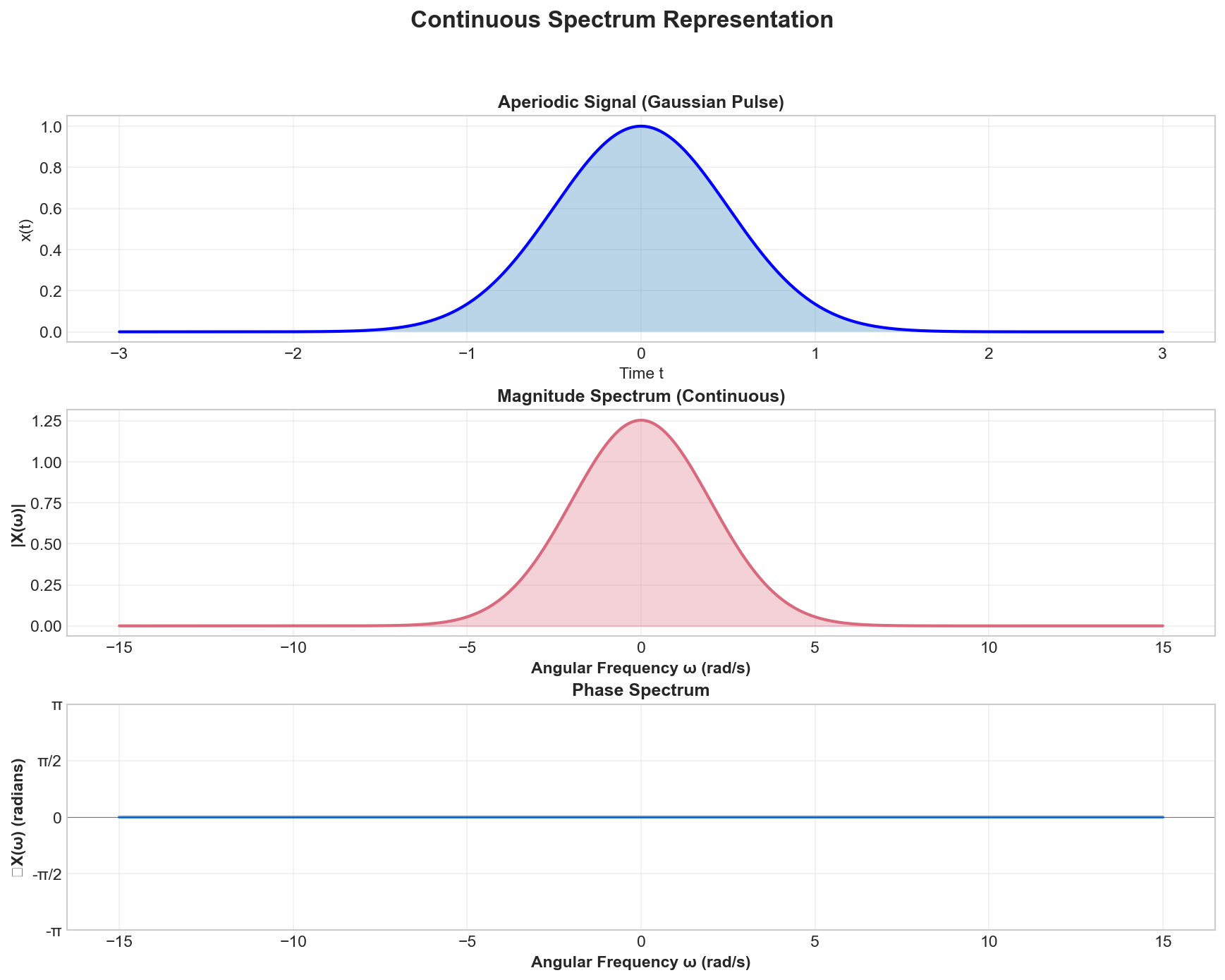
The figure illustrates a continuous spectrum for an aperiodic Gaussian pulse. Unlike the discrete line spectrum of periodic signals, the Fourier Transform produces a continuous frequency distribution. The magnitude spectrum (middle) shows the even symmetry property for real signals, and the phase spectrum (bottom) shows the odd symmetry. Notice that energy is distributed continuously across all frequencies, not just at discrete harmonics.
Fourier Transform of Periodic Signals
Link to Fourier Series
An interesting and important case occurs when we apply the Fourier Transform to a periodic signal. Although periodic signals have infinite energy and do not satisfy the standard conditions for the existence of the Fourier Transform, we can still define their Fourier Transform using the Dirac delta function (impulse function).
This establishes a direct connection between the Fourier Series (Chapter 3) and the Fourier Transform (Chapter 4).
Theorem: Fourier Transform of a Periodic Signal
Consider a periodic signal
where the Fourier series coefficients are:
The Fourier Transform of
Interpretation:
- The Fourier Transform of a periodic signal consists of impulses (Dirac delta functions) located at the harmonic frequencies
- The weight (area) of each impulse is
, where is the Fourier series coefficient from Chapter 3 - This converts the discrete line spectrum (Fourier Series) into a distribution of impulses (Fourier Transform)
- The line spectra from Chapter 3 (plot of
vs ) corresponds directly to the impulse magnitudes in the Fourier Transform
Demonstration
Starting from the Fourier Series:
We know that:
Taking the Fourier Transform of both sides:
By linearity of the Fourier Transform:
Fourier Transform of a Complex Exponential:
We need to find
More generally:
Final Result:
Substituting back:
This shows that the Fourier Transform of a periodic signal is a train of impulses at the harmonic frequencies, with weights proportional to the Fourier series coefficients.
Connection to Chapter 3:
Recall from Chapter 3 that the line spectrum represents:
- Magnitude spectrum: Plot of
versus (or versus ) - Phase spectrum: Plot of
versus (or versus )
The Fourier Transform representation gives us:
- Impulses at frequencies
- Impulse weights
(or magnitude and phase )
These are equivalent representations: the line spectrum shows discrete values at integer
Example: Square Wave
Consider the square wave from Chapter 3, Example 1, with Fourier series:
where for odd
The Fourier Transform is:
This shows impulses at
Visualization:
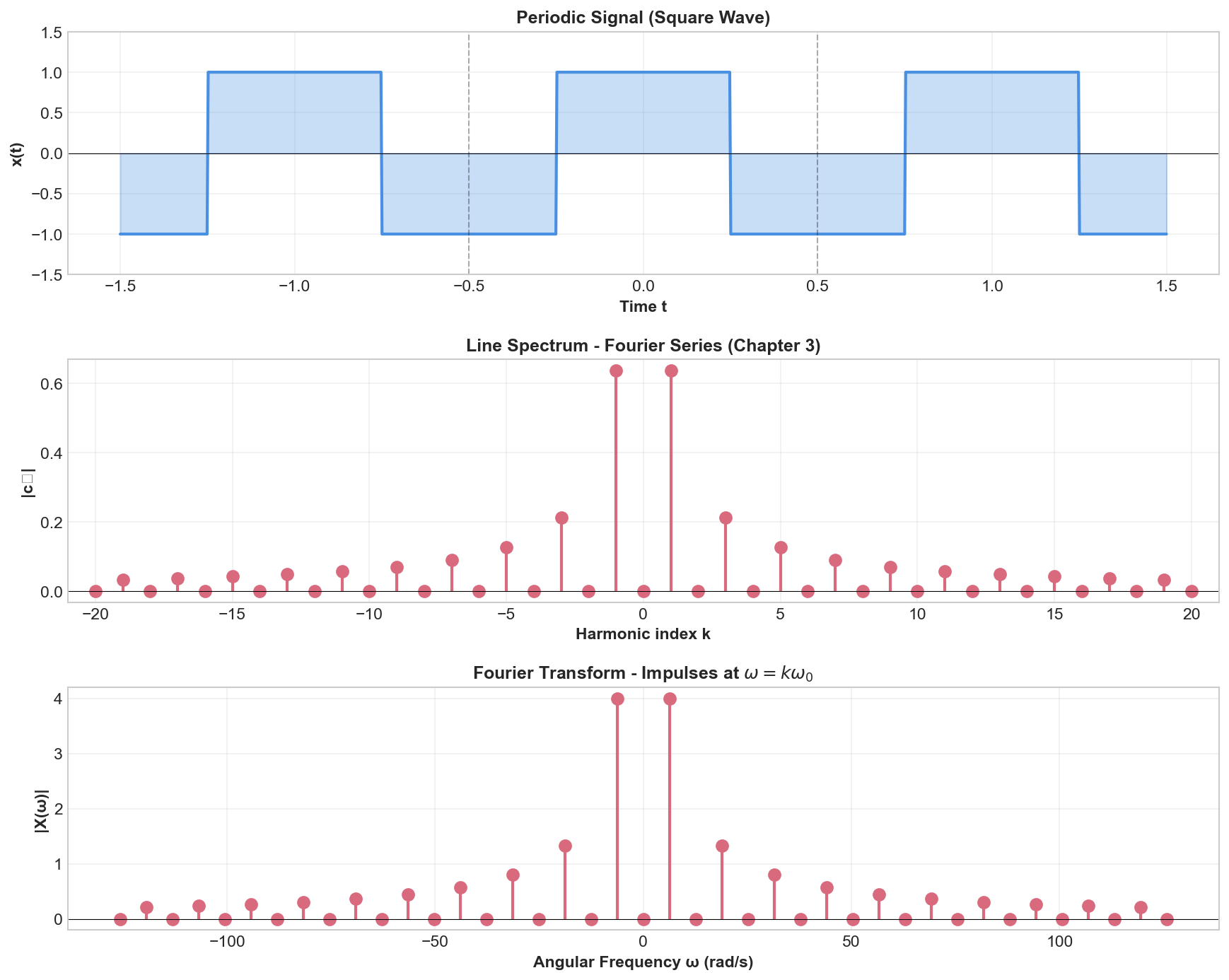
The figure compares the Fourier Series representation (line spectra from Chapter 3) with the Fourier Transform representation (impulses) for a periodic square wave. The top panel shows the periodic signal in time. The middle panel shows the discrete line spectrum from Chapter 3 (magnitude |c_k| versus k). The bottom panel shows the corresponding Fourier Transform with impulses at ω = kω₀, demonstrating that the two representations are equivalent: line spectra show discrete coefficients while the Fourier Transform shows impulses at the corresponding frequencies.
Key Points:
- Periodic signals → Discrete spectrum (impulses at harmonics)
- Aperiodic signals → Continuous spectrum
- The Fourier Series coefficients
from Chapter 3 directly determine the impulse weights in the Fourier Transform - As
(signal becomes aperiodic), the impulses merge into a continuous spectrum - This connection shows that the Fourier Series is a special case of the Fourier Transform for periodic signals
Examples
Example 1: Rectangular Pulse (Porte)
Consider a rectangular pulse of width
This is also written as
The Fourier transform is:
or equivalently:
Demonstration
Compute the Fourier transform:
Using Euler's formula:
Therefore:
This can be written as:
where
Key observations:
(the DC value is the area under the pulse) - The spectrum has zeros at
for - The first zero crossing occurs at
- Narrower pulse (smaller
) → wider spectrum (inverse relationship) - The spectrum decays as
for large
Visualization:
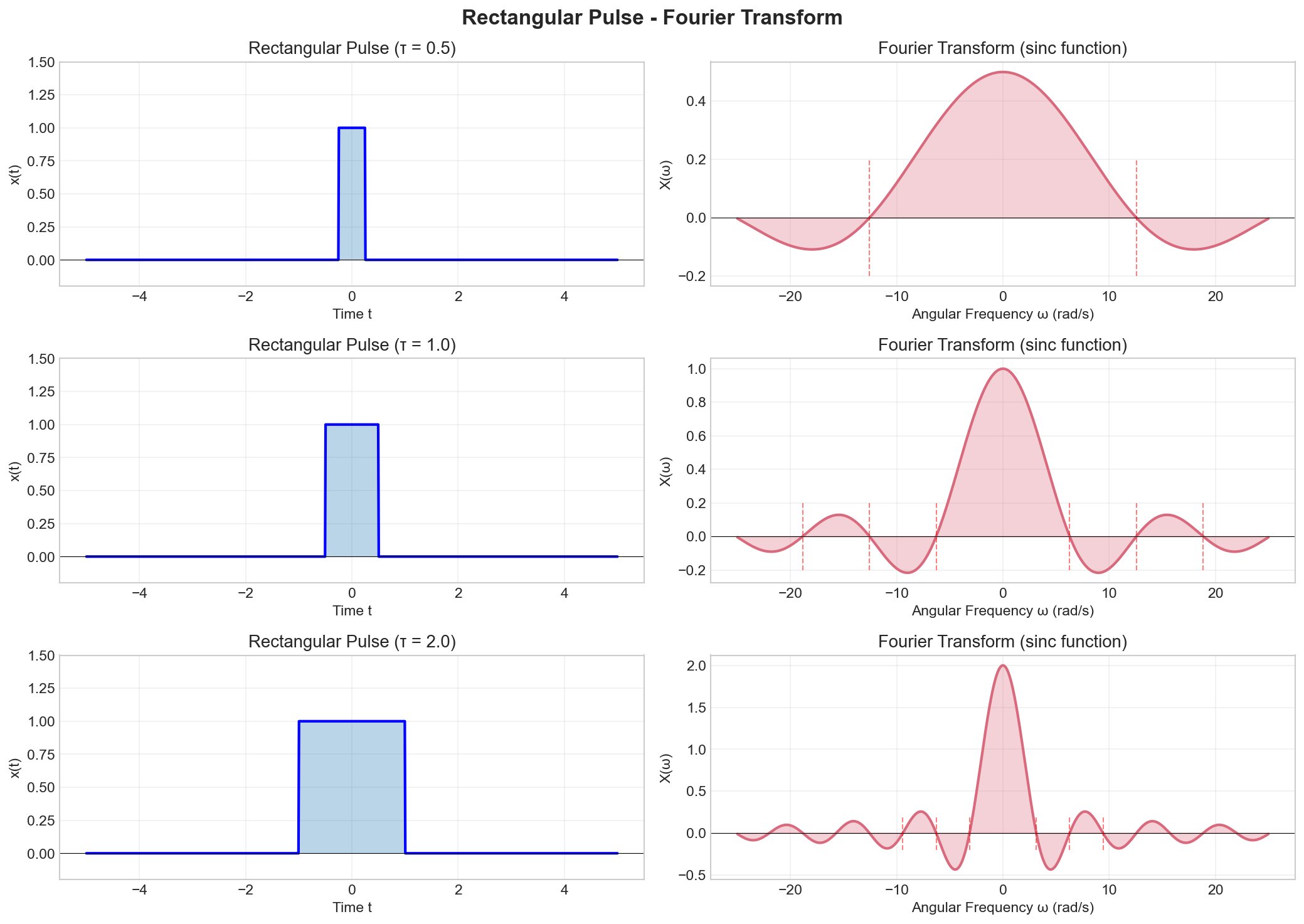
The figure shows rectangular pulses of different widths (τ = 0.5, 1.0, 2.0) and their corresponding Fourier transforms. The transform is a sinc function with zeros at ω = ±2πn/τ. Key observation: narrower pulses (smaller τ) have wider spectra, demonstrating the inverse time-frequency relationship. The first zero crossing moves further from the origin as the pulse becomes narrower.
Example 2: Exponential Decay (One-Sided)
Consider a one-sided exponential decay:
The Fourier transform is:
Demonstration
Compute the Fourier transform:
For
Magnitude and phase:
Key observations:
- The magnitude spectrum is a Lorentzian (decreases as
for large ) - At
: - At
: (half-power point) - Faster decay (larger
) → narrower spectrum
Visualization:
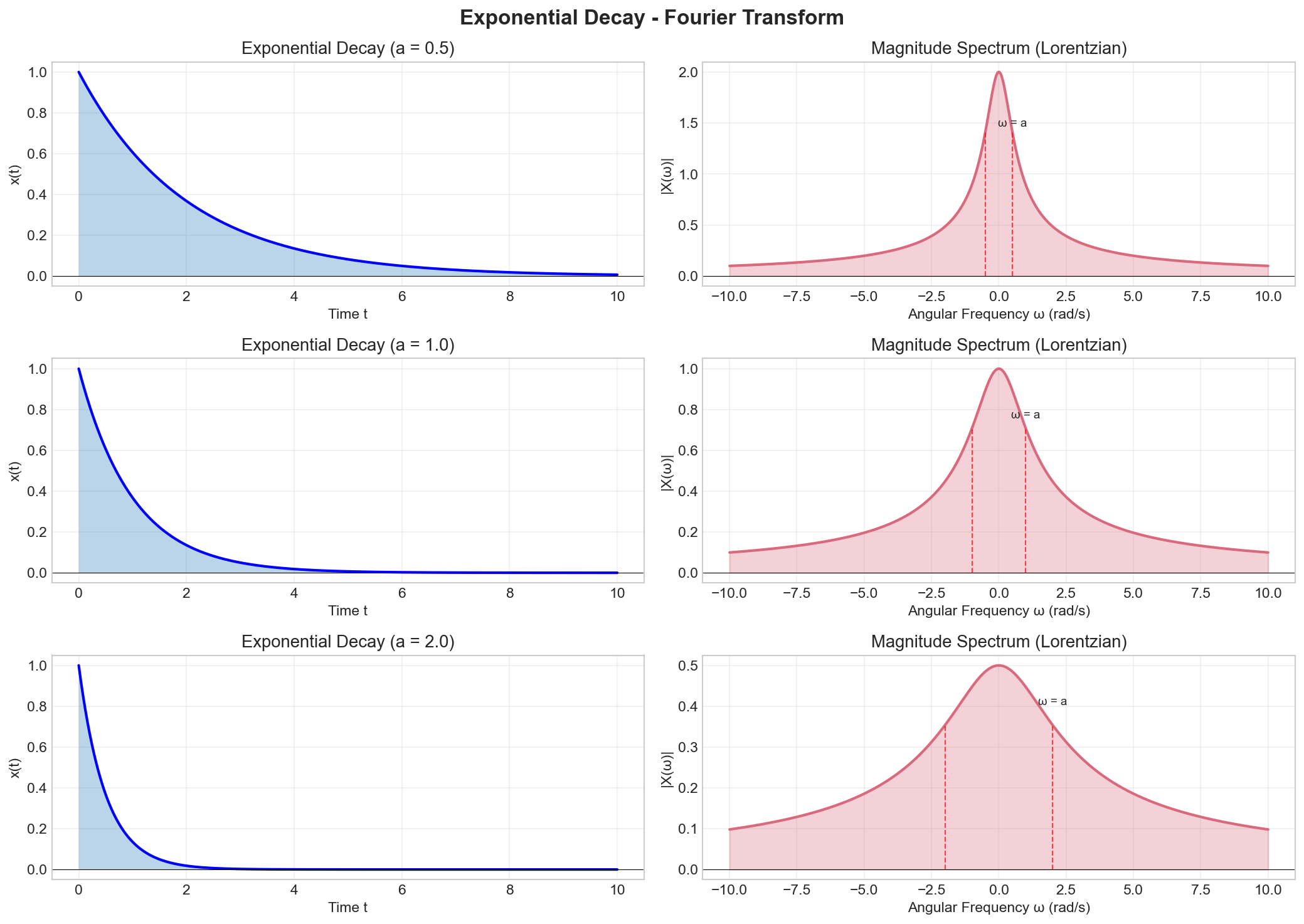
The figure shows exponential decays with different decay rates (a = 0.5, 1.0, 2.0) and their Lorentzian magnitude spectra. The half-power point occurs at ω = a, marked with dashed lines. Faster decay in time (larger a) leads to a wider spectrum in frequency, but the spectrum is still more concentrated at low frequencies. The Lorentzian shape is characteristic of exponential decay signals.
Example 3: Gaussian Pulse
Consider a Gaussian pulse:
The Fourier transform is also Gaussian:
Demonstration
The Fourier transform of a Gaussian is well-known and can be computed using the property:
Starting with:
Complete the square in the exponent:
Therefore:
Using the substitution
We get:
Key observations:
- The Fourier transform of a Gaussian is also a Gaussian (self-reciprocal)
- Wider pulse (larger
) → narrower spectrum (smaller in frequency) - This demonstrates the uncertainty principle:
constant - Gaussian has the minimum time-bandwidth product
Visualization:
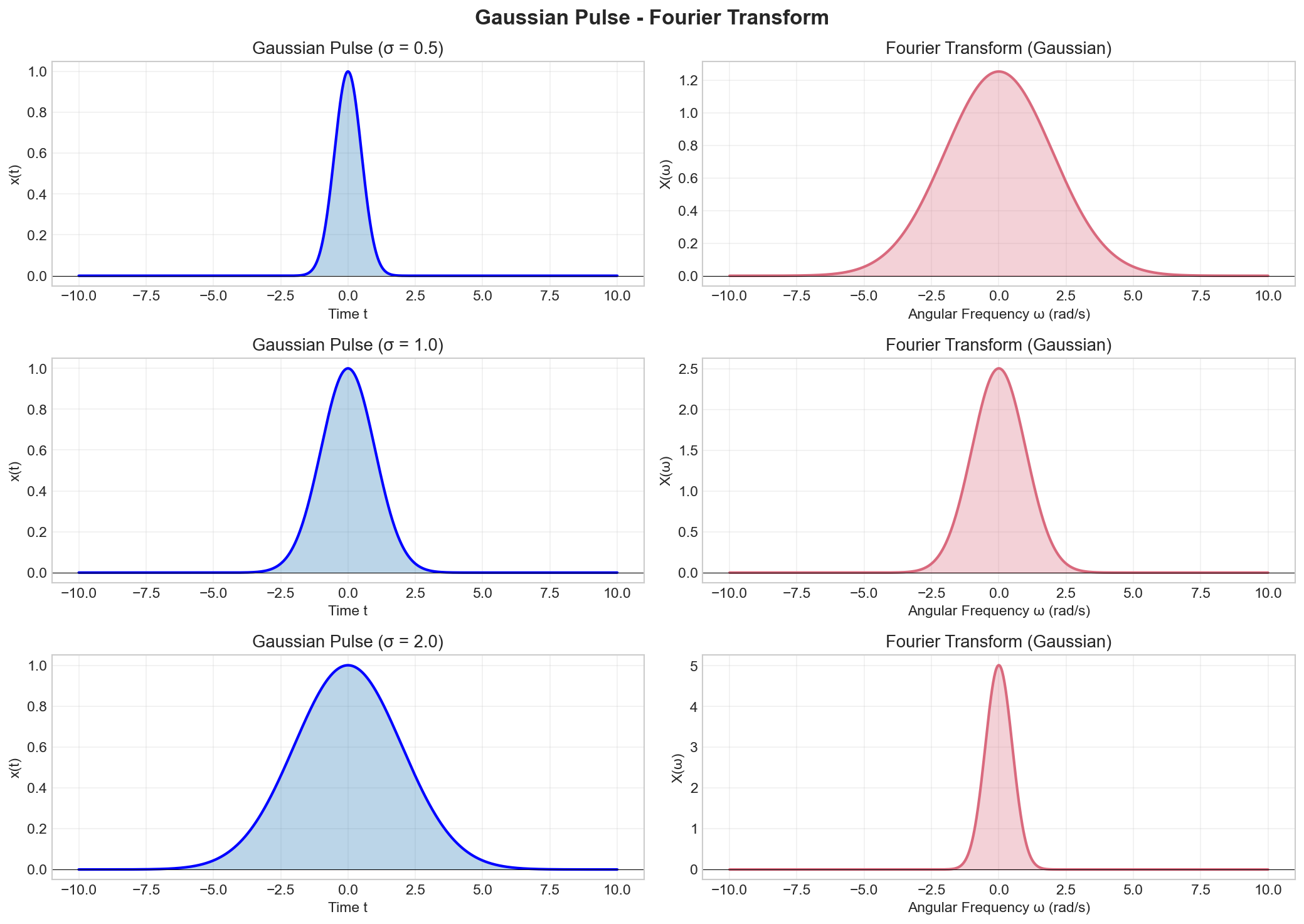
The figure shows Gaussian pulses with different widths (σ = 0.5, 1.0, 2.0) and their Gaussian Fourier transforms. This is a remarkable property: the Fourier transform of a Gaussian is also a Gaussian (self-reciprocal). The time-frequency duality is clearly visible: wider pulses in time (larger σ) produce narrower spectra in frequency. Gaussians achieve the minimum time-bandwidth product, making them optimal for localization in both domains simultaneously.
Example 4: Amplitude Modulated (AM) Signal
Consider an amplitude modulated signal where a carrier at frequency
where:
is the carrier amplitude is the modulation index (0 ≤ m ≤ 1) is the message frequency (low frequency) is the carrier frequency (high frequency, )
The Fourier transform is:
Demonstration
Expand the signal:
Using the product-to-sum identity:
The Fourier transform of
Therefore:
Key observations:
- The spectrum has three components:
- Carrier: at
- Lower sideband (LSB): at
- Upper sideband (USB): at
- Carrier: at
- The carrier amplitude is
- The sideband amplitudes are
(proportional to modulation index) - Bandwidth:
(centered at carrier frequency) - AM signal occupies frequency bands around the carrier
Visualization:
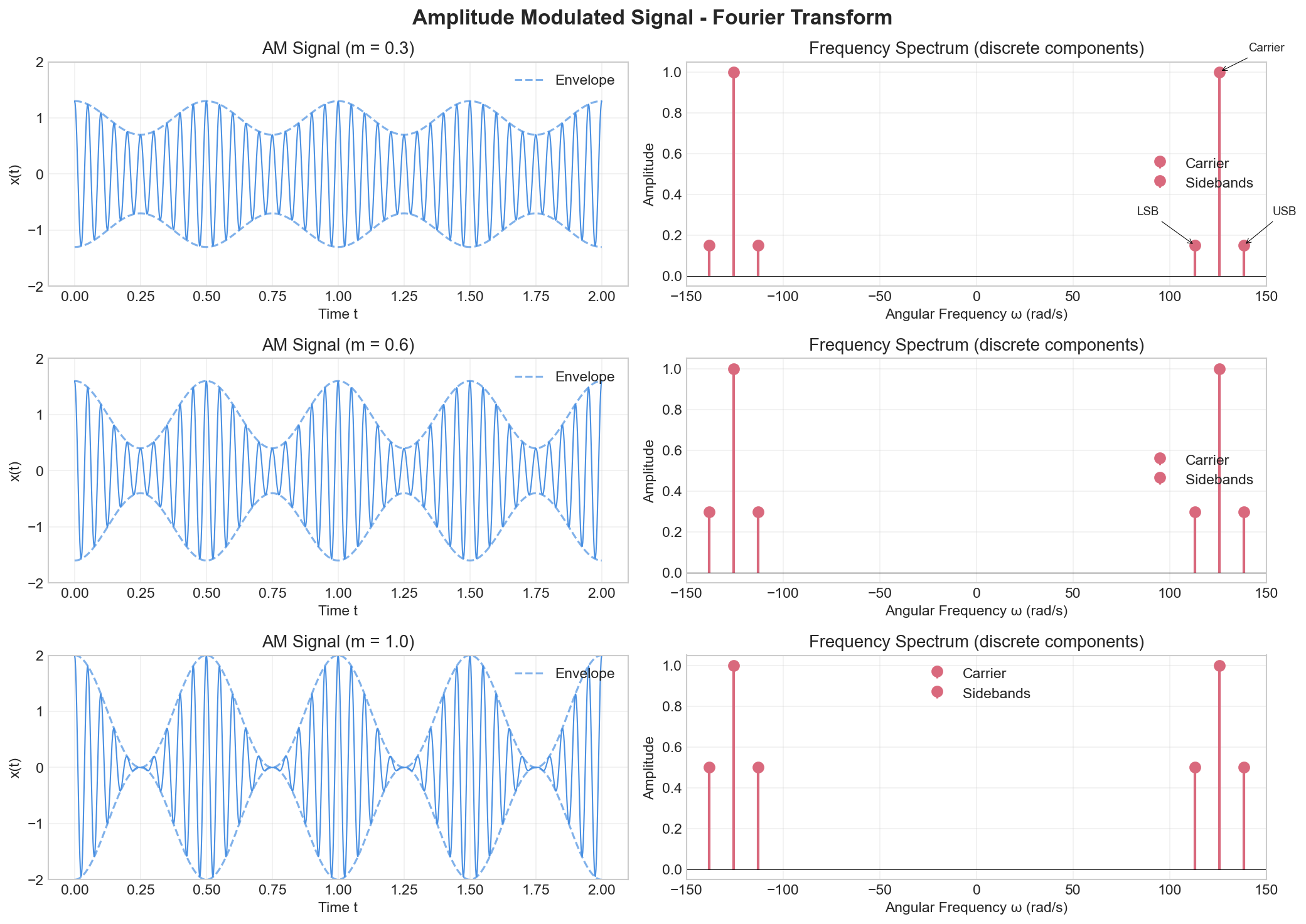
The figure shows AM signals with different modulation indices (m = 0.3, 0.6, 1.0). The time domain shows the characteristic amplitude variation following the message signal envelope. The frequency domain shows the three-component spectrum: a strong carrier component at ω_c and two sidebands at ω_c ± ω_m. As the modulation index increases, the sideband amplitudes grow relative to the carrier, carrying more information. The bandwidth is always 2ω_m regardless of the modulation index.
Example 5: Frequency Modulated (FM) Signal
Consider a frequency modulated signal:
where:
is the carrier amplitude is the carrier frequency is the modulation index (frequency deviation ratio) is the message frequency
Using the Jacobi-Anger expansion, the FM signal can be expressed exactly as:
where
The Fourier transform is:
Properties of Bessel functions:
(for integer ) (power conservation) - For small
: , , for - For large
: significant sidebands up to
Demonstration
The exact expansion using the Jacobi-Anger identity:
Applying this to the FM signal:
Each term
Key observations:
- Narrowband FM: Similar spectrum to AM (carrier + 2 sidebands), but with phase relationships
- Wideband FM: Multiple sidebands at
, amplitudes decay according to Bessel functions - Bandwidth (Carson's rule):
- Larger
→ wider bandwidth but better noise immunity - FM provides better signal-to-noise ratio than AM
Visualization:
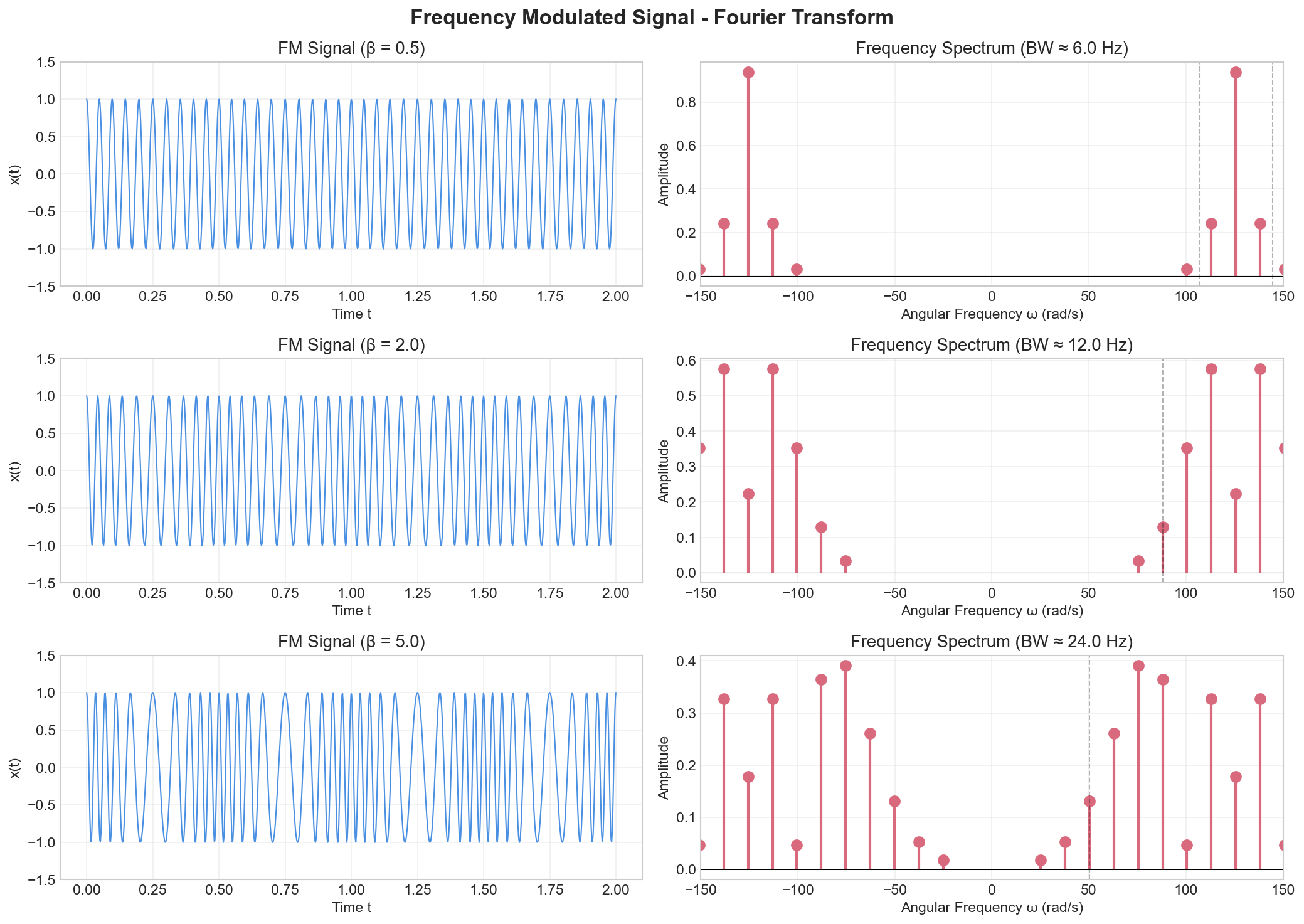
The figure shows FM signals with different modulation indices (β = 0.5, 2.0, 5.0). For narrowband FM (β = 0.5), the spectrum is similar to AM with a carrier and two sidebands. As β increases (wideband FM), multiple sidebands appear at ω_c ± nω_m, with amplitudes following Bessel function profiles. The bandwidth increases with β according to Carson's rule: BW ≈ 2(β + 1)ω_m. This demonstrates the frequency-domain trade-off in FM: wider bandwidth provides better noise immunity.